

AAcross the United States, the fathers’ rights movement is gaining momentum as lawmakers, courts, and advocacy organizations increasingly recognize the importance of both parents in a child’s life. For decades, many divorced fathers have faced challenges in family courts when seeking fair custody arrangements and meaningful parenting time. Today, new legislation and growing public awareness are beginning to reshape the conversation.
Organizations like Equal Rights for Divorced Fathers are working to ensure that family law reflects a simple but powerful principle: children benefit most when both parents remain actively involved in their lives.
This article explores the latest developments in fathers’ rights, shared parenting laws, custody reform, and the ongoing effort to create fairness in family courts.
The Evolution of Fathers’ Rights
Historically, family courts in the United States operated under what was known as the “tender years doctrine.” This legal philosophy assumed that young children were best cared for by their mothers. While this doctrine was largely phased out during the late twentieth century, many fathers’ rights advocates argue that its influence continues to shape custody decisions today.
Over time, family law shifted toward a “best interests of the child” standard. While this standard is intended to be neutral, critics say it sometimes allows subjective interpretations that can unintentionally favor one parent over the other.
As research on child development has advanced, experts increasingly agree that children thrive when they maintain strong relationships with both parents after divorce or separation. This growing body of evidence has fueled a nationwide push for shared parenting reforms.
The Rise of Shared Parenting Laws
Shared parenting refers to custody arrangements in which both parents maintain substantial and meaningful time with their children. These arrangements can vary but often aim for roughly equal parenting time.
Supporters of shared parenting laws argue that they:
✔ Promote stronger emotional bonds between children and both parents
✔ Reduce parental conflict by establishing clear expectations
✔ Encourage cooperative co-parenting
✔ Improve long-term outcomes for children
Several states have taken major steps toward recognizing shared parenting as the preferred custody arrangement.
States Leading Fathers’ Rights Reform
Kentucky: A National Precedent
Kentucky made history when it became the first state to establish a strong legal presumption of joint custody and shared parenting time.
Under Kentucky’s law, courts begin custody cases with the assumption that equal parenting time is in the best interests of the child, unless evidence proves otherwise.
The law has significantly influenced fathers’ rights advocacy nationwide and is often cited as a model for other states.
Florida: Equal Time-Sharing Legislation
Florida passed legislation encouraging courts to begin custody decisions with a presumption of equal time-sharing between parents.
The law recognizes that children benefit when both parents remain actively involved in their upbringing, and it encourages judges to support balanced parenting arrangements whenever possible.
Missouri: Promoting Frequent Contact With Both Parents
Missouri enacted legislation affirming that children benefit from frequent, continuing, and meaningful contact with both parents.
Missouri courts are encouraged to consider parenting plans that allow children to maintain strong relationships with both mother and father.
New Fathers’ Rights Legislation Across the United States
Several states are currently considering legislation designed to promote parental equality in custody cases. These bills aim to create a more balanced starting point in family courts.
Common provisions include:
Rebuttable Presumptions of Shared Parenting
Some proposals establish a rebuttable presumption that equal parenting time is best for the child. This means courts must start with the assumption of shared parenting unless evidence suggests otherwise.
Joint Custody as the Default
Other bills seek to make joint custody the default arrangement when both parents are fit and capable.
Increased Accountability for Custody Decisions
Some proposed reforms would require judges to explain in writing when they deny equal parenting time.
These efforts aim to ensure custody decisions are transparent, fair, and based on evidence.
Child Support Reform and Fathers’ Rights
Custody arrangements are closely tied to child support laws. Many fathers’ rights advocates argue that outdated support formulas can create financial pressures that discourage balanced parenting arrangements.
Several states have begun updating child support guidelines to reflect modern family structures.
For example:
- Washington implemented updates to child support guidelines beginning in 2025.
- Pennsylvania simplified custody evaluation factors to reduce legal complexity.
These changes are intended to make family law more efficient and accessible while ensuring that children receive the financial support they need.
The Importance of Fathers in Child Development
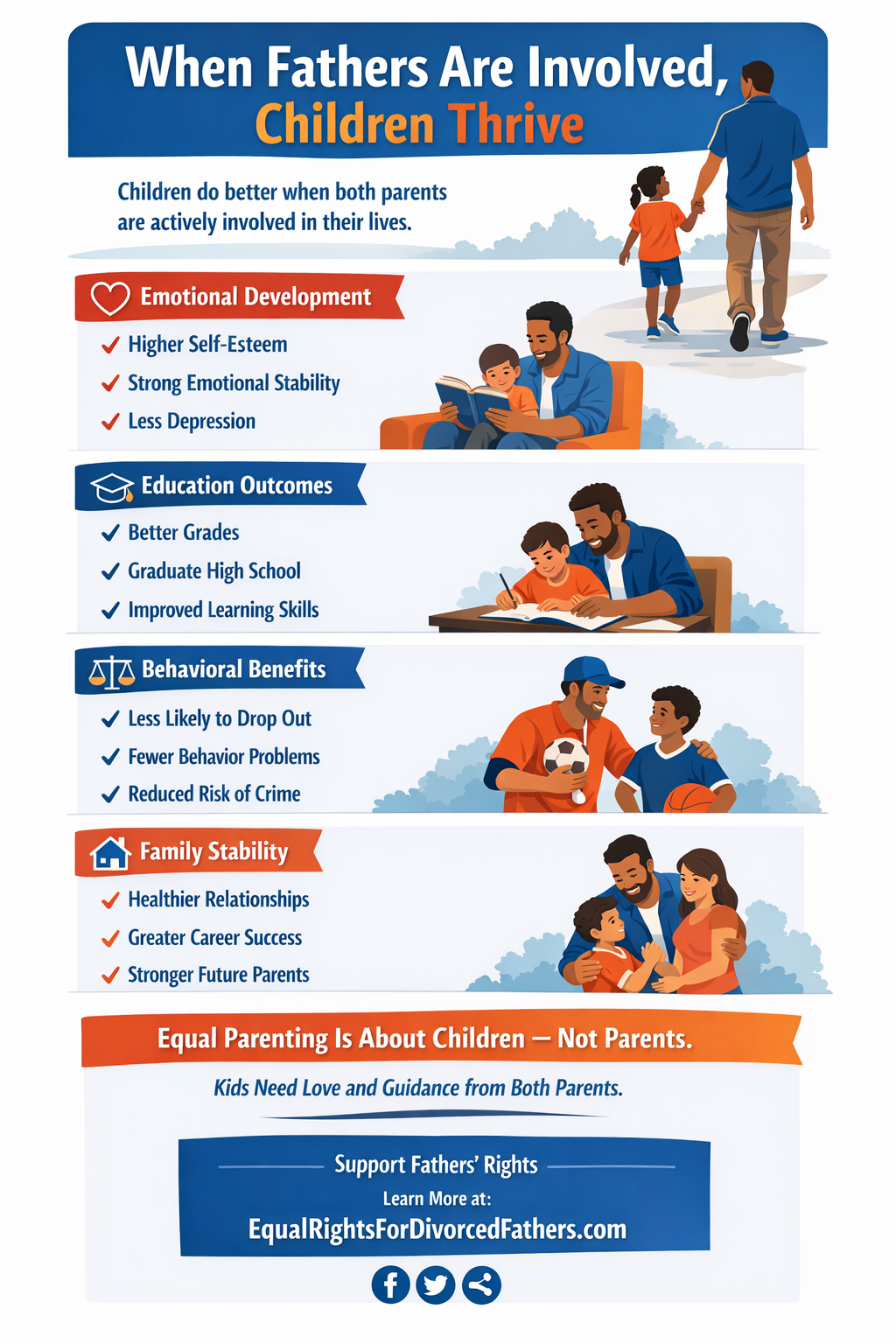
Extensive research demonstrates the critical role fathers play in their children’s lives.
Children with involved fathers often experience:
📚 Better academic performance
💬 Stronger emotional development
⚖ Lower rates of behavioral problems
❤️ Greater self-confidence and stability
Fathers provide unique forms of support, mentorship, and guidance that contribute significantly to a child’s growth.
Recognizing this reality is central to the fathers’ rights movement.
Challenges Fathers Still Face in Family Courts
Despite legal reforms, many fathers still report challenges when navigating custody disputes.
Common concerns include:
Limited Parenting Time
Some fathers receive minimal visitation schedules that limit their ability to participate in everyday parenting activities.
High Legal Costs
Family court cases can become expensive, especially when disputes over custody escalate.
Enforcement of Parenting Orders
In some cases, parenting time orders are difficult to enforce, leaving fathers with limited recourse when visitation schedules are violated.
False Allegations in Custody Disputes
Custody conflicts sometimes involve allegations that complicate legal proceedings and prolong court battles.
Addressing these challenges remains a priority for fathers’ rights advocates.
The Role of Fathers’ Rights Organizations
Advocacy organizations play a crucial role in raising awareness and promoting policy reform.
Groups like Equal Rights for Divorced Fathers focus on:
✔ Educating fathers about their legal rights
✔ Advocating for shared parenting legislation
✔ Supporting families navigating custody disputes
✔ Promoting fairness in family courts
Through community outreach and policy advocacy, these organizations aim to ensure that fathers receive equal treatment under the law.
The Future of Fathers’ Rights
The national conversation about fathers’ rights continues to evolve. Public attitudes toward parenting roles have changed dramatically in recent decades, with more families recognizing the importance of shared responsibility.
Several trends are likely to shape the future of fathers’ rights:
Expansion of Shared Parenting Laws
More states are expected to consider legislation promoting equal parenting time.
Increased Transparency in Family Courts
Advocates are pushing for clearer standards and accountability in custody decisions.
Technology and Co-Parenting Tools
Digital tools are helping parents coordinate schedules, track parenting time, and reduce conflict.
Greater Public Awareness
Media coverage and advocacy efforts are bringing attention to the challenges fathers face in custody disputes.
Together, these developments could lead to a more balanced and equitable family court system.
Why Equal Parenting Matters
At the heart of the fathers’ rights movement is a simple idea: children deserve the love and guidance of both parents whenever it is safe and possible.
Equal parenting is not about competition between mothers and fathers. Instead, it is about creating a system that recognizes the importance of both parents in raising healthy, well-adjusted children.
When family courts support meaningful relationships with both parents, everyone benefits—especially children.
Get Involved
If you believe in fairness in family courts and the importance of both parents in a child’s life, consider supporting the mission of Equal Rights for Divorced Fathers.
By raising awareness, advocating for legal reform, and supporting families in need, we can work together to create a system that truly prioritizes the well-being of children.
Visit
https://equalrightsfordivorcedfathers.com
Learn how you can help advance fathers’ rights and promote equal parenting.





Leave a Reply